As I am currently trapped in my room awaiting the promised carnage (or slight amount of wind) of Typhoon Vongfong (Typhoon 19 of this Typhoon season) I feel I should crack on with this blog for fear it will be a one-post-wonder. The typhoon itself is shaping up to be pretty impressive – I have been told it’s the size of Germany and my teacher today spoke of trees coming down later, so pretty serious stuff. Serious enough that they have cancelled all classes today from period 2 onwards (from 10:15am) though this was of little comfort to me at 8am this morning when I discovered the storm-that-was-promised was running late and I would actually have to get out of bed. Hopefully Vongfong can make up for it (and make up for sounding like its been sponsored by a mobile phone network) by delaying my classes tomorrow instead. This isn’t to say I don’t enjoy my classes, just that I am very much not a morning person in any way whatsoever. Enjoy this satellite image of Vongfong for your viewing pleasure (this one was taken a day ago, so not as scary looking as it was on Thursday), hopefully it doesn’t cause too much real destruction.

We had a typhoon last week as well (Typhoon Phanfone) but, despite class being cancelled, it was incredibly anticlimactic. My university follows the protocol that if the public transport between Osaka and Kyoto isn’t running then classes will be cancelled – JR closes lines if there is a severe weather warning.
Today, in an attempt to forget about the fact that I can’t actually leave my room, I will talk about a trip to Kurama I took a few weeks ago as a way of getting out of the city. Though I had just arrived in Kyoto at that point, it was incredibly hot and humid and I wanted to find some air that doesn’t stick to you and make you feel like a frog (蒸し暑い – mushi atsui, hot and sticky, is a term you hear frequently to describe Japanese weather, something that makes me dread June and July). Fortunately Kyoto is surrounded by mountains, so I decided I would attempt to get to them. Luckily for me I live near the train line that goes directly into the mountains – If you catch the train North from Demachiyanagi Station (出町柳駅) you can travel all the way up to Kurama (last stop on the line) for 420円 one way (£2.40). Unfortunately the Japanese rail lines don’t seem to do returns, so it’s really a 840円 round trip – still pretty cheap and the train only takes half an hour. I went with my friend Lexi who was also keen to explore and get out of the city.
At the time I had no real idea where we were going or what we would see (I had just traced the line up on google maps and decided to go) – there was a distinct possibility we would end up in the middle of nowhere and have to turn around straight away. It soon became apparent that this was not the case – the train was packed full of people with map guides and backpacks; clearly something was on this train line. Upon arrival at the station we found a map that showed there was a temple complex and leaving the station we were greeted by a huge red-faced deamon-god thing with a long red nose. This is in fact a Tengu – one of many Japanese Shinto Kami. While the topic of Japanese religion is way too long to go into without derailing this post entirely, Kami (神) are akin to spirits and are often concerned with specific areas, similar to the specifications of Roman gods though Kami are far more numerous and less all-powerful over their area.

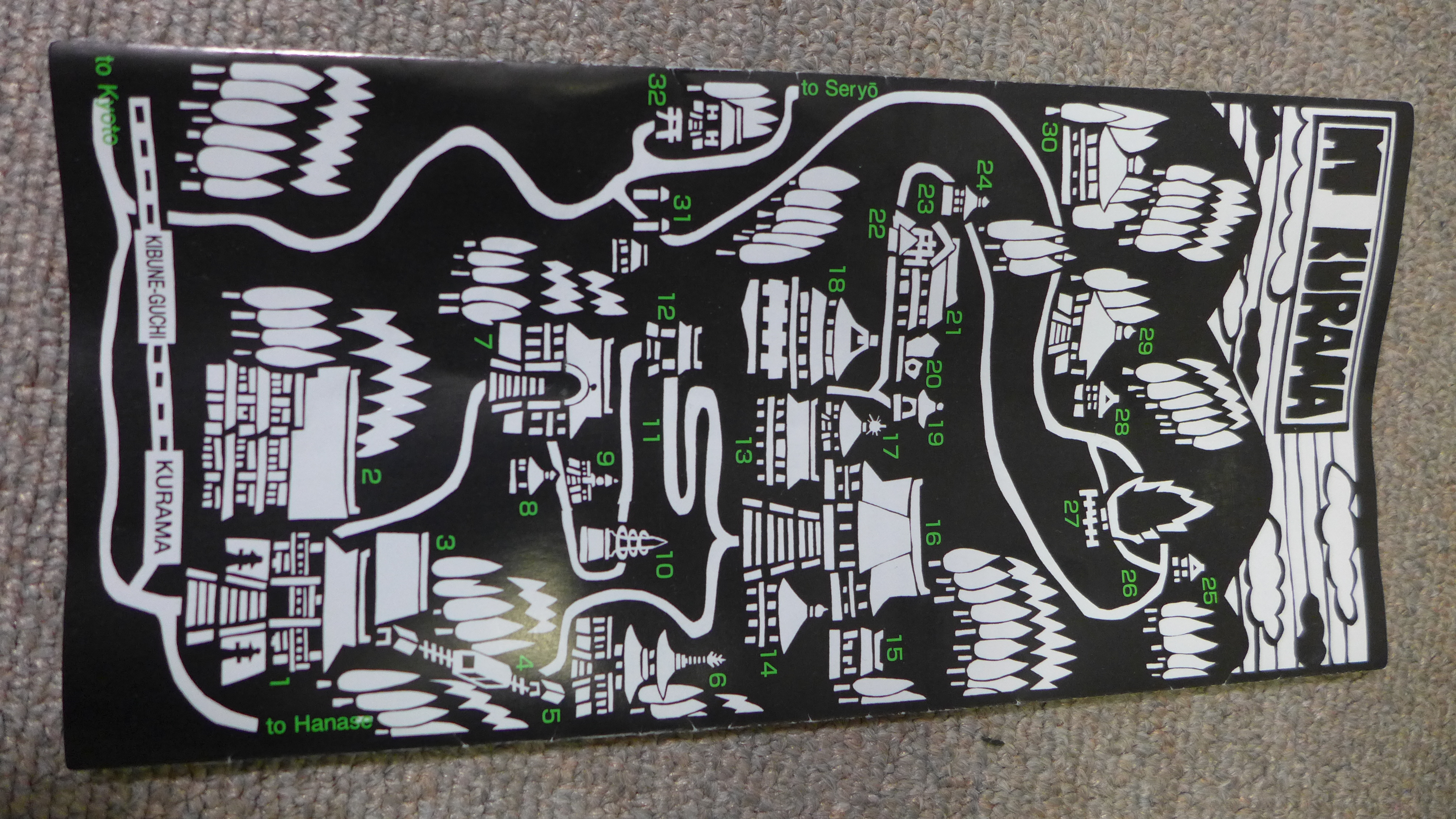
Kurama-dera (鞍馬寺) and its complex of shrines begins just a short walk from Kurama station – walking through a street of souvenir shops (many selling Tengu masks, charms etc. as well as sweets) you quickly come to steps up to a temple entrance gate. Upon arrival you pay 200円 (£1.15) to the old men at the ticket kiosk and in return you get entrance and a leaflet (in English) that tells you about the temple and the shrines that comes with a map and a poem about the temple. There were also walking sticks at the bottom that can be borrowed if needed. There was a cable car up the mountain but Lexi and I opted to walk which turned out to be a good decision as otherwise you would miss a huge amount of the shrine complex. On the way up there are many small shrines tucked away in the forest, as well as small animal statues hidden among the roots. If walking up hill was an issue I would strongly recommend getting the cable car up and then walking down through the shrines.
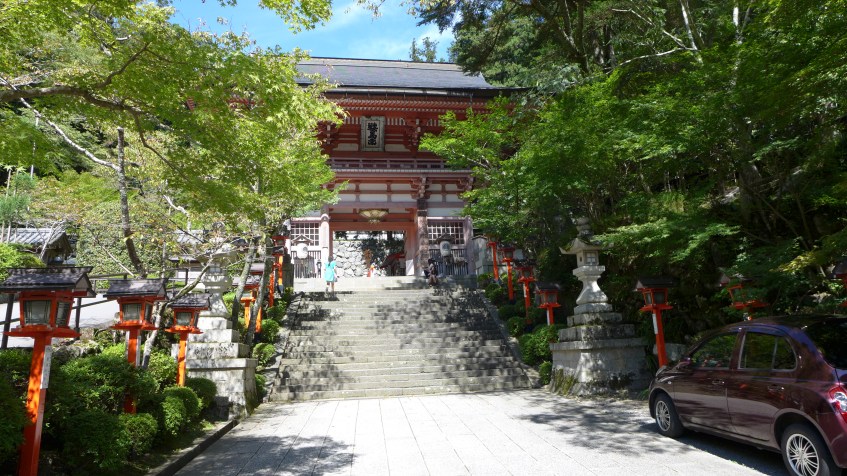
The complex itself covers about a kilometer up the mountain and is home to Yuki Shrine (由岐神社) as well as Kurama temple. Yuki shrine is actually a collection of several shrines and home to some impressively tall trees that I think were redwoods, though I could not tell you for certain. These trees were girdled with rope which has lightning shaped paper wards hanging from it, something you see all over Japan at temples and sometimes above doorways. You may be wondering why the mountain needs a shrine if it has a temple – The difference between Yuki shrine and Kurama temple is that Yuki is a Shinto shrine while Kurama Temple is Buddhist. It is quite common to see shrines and Buddhist temples near each other in Japan as most people follow both religions (again, religion in Japan is far too broad a topic to go into here though I may write about it in more detail separately) and both religions see mountains as sacred places. Yuki shrine is also famous because on October 22nd each year they hold the fire festival which, of course, involves a lot of dancing around with fire. I hope to go and will definitely write about it if I do!

Mount Kurama is also famous as it is the place where Reiki was invented – you may have seen Reiki before if you’ve been to a carnival or market and seen someone performing elaborate hand movements over someone sitting down without ever actually touching them. The idea behind Reiki being that the performer can sense the negative energies within someones’ ‘aura’ and cleanse them by ‘pulling’ out these negative energies with their hands – hence the swirling of their hands around their client’s head and body. If you want to see an example there are plenty of people on YouTube who seem to think it also works through the internet.
We walked all the way up to Kurama temple where we saw the monks in action – chanting and hitting a wooden block. The monks wore simple clothing and continue the practice of Buddhism at the temple that originated in 770 (though the sect has changed from its original founding). Although outwardly the monks appear to be following all the same traditions with their clothes and food, the monk’s offices were pretty swish (not entirely sure why they need them but I guess everywhere needs admin, strange to think that someone’s job is the IT guy for a load of Buddhist monks).

Sneaky peek into the monks’ swag pad
The view from the mountain itself is spectacular and worth the walk even without the temples and shrines in between. I would love to see the sunset from up there. The forest is also cooler than the heat of Kyoto though it was still hot enough to warrant stopping for a drink. There are restrooms the whole way up (literally one every 300m) as well as a vending machine and snack shop half way up. It is possible to hike over the mountain to the village on the other side but we were pressed for time so we didn’t. The trip is also possible at night as there are lamps all the way up the mountain. I would recommend allowing about 2 – 3 hours at least to explore the temple complex without feeling rushed – the trains run every 15 minutes or so so worrying about missing the train is not an issue.


That pretty much covers Kurama, a trip I would highly recommend if you visit Kyoto – it isn’t as packed as the main temples and also out of the heat while still being a beautiful complex. The typhoon is definitely here now – the wind is really loud and it sounds like my teacher will be right about the trees coming down! Hope this was an interesting read – if you click on the top menu you can put in your email to subscribe to my blog as I don’t want to spam everyone on Facebook every time I write a post. Also I’m not going chronologically, I will go back over settling in and other things I’ve been up to – I just felt like writing about this today.