
Today I tell a tale of woe. A tale of that day when everything goes wrong. The day when you manage to break your laptop three days after arriving in Japan.
The Friday after I arrived in Kyoto, we had gone to Kamigyo-ku’s kuyakusho (ward office for my area) in an attempt to get our residence cards registered only to find that it was closed for a public holiday. In order to feel better about our failure to get anything useful done that day we were going to hit the hundred yen shops (a magical land of plenty), so I popped into my room to grab some money. As I reached over to grab some cash, I stepped back and caught the edge of my laptop with my foot. No crunch. No dying scream. Not even a whir. All seemed well. I left to join my friends. We couldn’t find the shop so I went back into my room to check where it was on Google maps, only to discover lines dominating the login screen. Lines shaking up and down the screen. My stomach dropped through the floor as I realised that I had unwittingly embarked on a journey to repair my own idiotic mistake.

At this point you are probably wondering why my laptop was on the floor – I hadn’t yet got an extension cable for my charger and the floor was the easiest place to put it when charging. I have now learned that I should never EVER put my laptop on the floor. Lesson Number 1: your stuff is not invincible, you can break it. Be nice to your stuff.
At this point I’m panicking. I know a few things:
- My laptop is the only way to access the internet and therefore contact my friends and family. (My phone doesn’t work yet and the last owner of my room was kind enough to change the default WiFi password to stop me from getting in.)
- It is a public holiday. In all likelihood there will be no electronics shops open until Tuesday.
- It’s probably just the screen that’s broken – I can vaguely see the login screen among the lines of doom.
- I will now have to try to get this fixed in Japanese.
- The maker of my laptop (lenovo) does not sell to Japan.
- This is going to suck.
My options are thus:
- Phone parents and cry
- Try to get a monitor and HDMI cable asap so I can still communicate with the world
- Take it to a laptop repair shop (weirdly there is one at the end of my street, perhaps this was preordained. Perhaps I’m just an idiot)
I went through all of them in reverse order:
The repair shop said they would need to take it in for investigation because the hard drive could be damaged (cue more panic). Turns out that they asked me if I dropped it and I said yes because I have no idea what the word for ‘to step on’ is in Japanese (I now know very well – 踏む – fumu) and a dropped laptop is probably way more damaged than just a cracked screen. I decided I wasn’t ready to relinquish any hope of having the internet and resolved to return it after the weekend (the shop was shut for the public holiday all weekend anyway).
I then ran around town like a headless chicken trying to find its head, hunting for an electronics shop. Turns out google maps is not always your friend and will lie to you. Also the word ‘electronics’ can just mean a company that vaguely deals with electronics rather than an actual shop that sells monitors. You can try asking the workers in the convenience stores but they won’t have a clue. I eventually went to Kitaoji department store where they have an electronics shop on the top floor. Spent way too much money on a monitor (which is great for watching films on, so I found some silver lining) and returned to my room mildly relived.
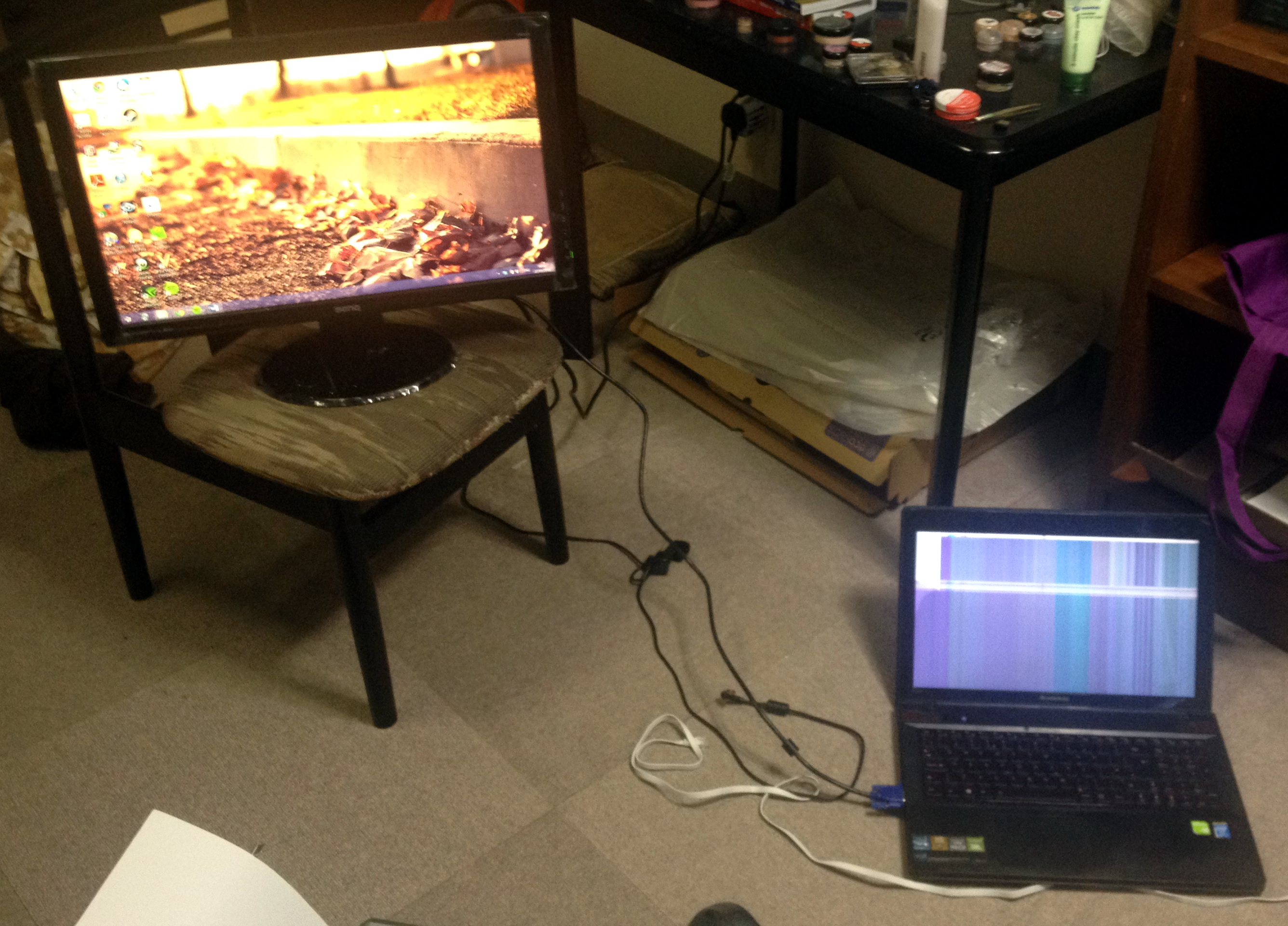
On the train to Kitaoji, I did what anyone that just arrived in a foreign country and broke their most important possession would do – I phoned my parents, cried and apologised for being an idiot. Turns out dad did exactly the same thing when he visited Tokyo on business. I think there is a family curse at work here.
On Wednesday (my birthday was Tuesday and I really needed to have internet access to arrange things) I submitted my laptop for inspection to the repair shop, having to attempt to understand the repair guy that they skyped in to explain stuff to me. Naturally this was all in Japanese. Thankfully Japanese words for technology tend to be pretty close to the English – screen is sukuriin (スクリーン)and ‘computer’ is an abbreviation of Personal Computer – pasokon (パソコン).
The lack of internet meant I was now having to walk to 7/11 every time I needed WiFi. My closest 7/11 is about 10 minutes’ walk away. Hardly ideal. (7/11 is great – the WiFi is free and you don’t have to register like you do at Family Mart or Lawson).
Though the shop said they would contact me in a couple of days I heard nothing for a week. I eventually went into the shop to ask. The girl at the desk was clueless and said to wait for contact from the repair guy. By strange ‘coincidence’ he calls me about half an hour after I get back. He explains that they would have to ship the part from overseas so I would have to wait. I explain in terrible Japanese that I really need it back in the interim for internet access (I used virtual router to get wifi on my phone – it’s a program that turns your laptop into a WiFi hotspot). I get laptop back the next day.
I decide that I can’t deal with no internet again when I hand my laptop back in so I make the trip to Yodobashi Camera, the gigantic electronics store near Kyoto station. There I managed to explain to a shop attendant that I needed something that would give me WiFi from an Ethernet cable without the need for online registration. Thankfully these adapters exist for people wanting to change hotel Ethernet into wireless. I got an elecom hotel wifi adapter, and I even got to choose the colour (red). You just scan the enclosed QR code with your phone and it automatically connects you. There is also a password that works for all devices. Mercifully there were instructions in English. I now use it as my main WiFi source for my room. It has a really strong signal even though I got the weakest one. It is tiny and just needs mains power and an Ethernet connection. It was definitely worth purchasing.

My laptop went in for repair for a second time and it took them 4 days to fix it. Looking at it now you would never know anything bad happened. It probably remembers and is biding its time waiting for revenge. Perhaps it will crash out of my next essay or update half way through an important skype call.
All in all, my spoken Japanese improved through negotiating with the IT people and for the majority of the ordeal I managed to keep my cool. I think the most important lesson is to not cry over spilt milk – all you can do is mop it up and carry on. That and never EVER leave your laptop on the floor.




















 japangie