清水寺 Plunging into a Sea of Leaves

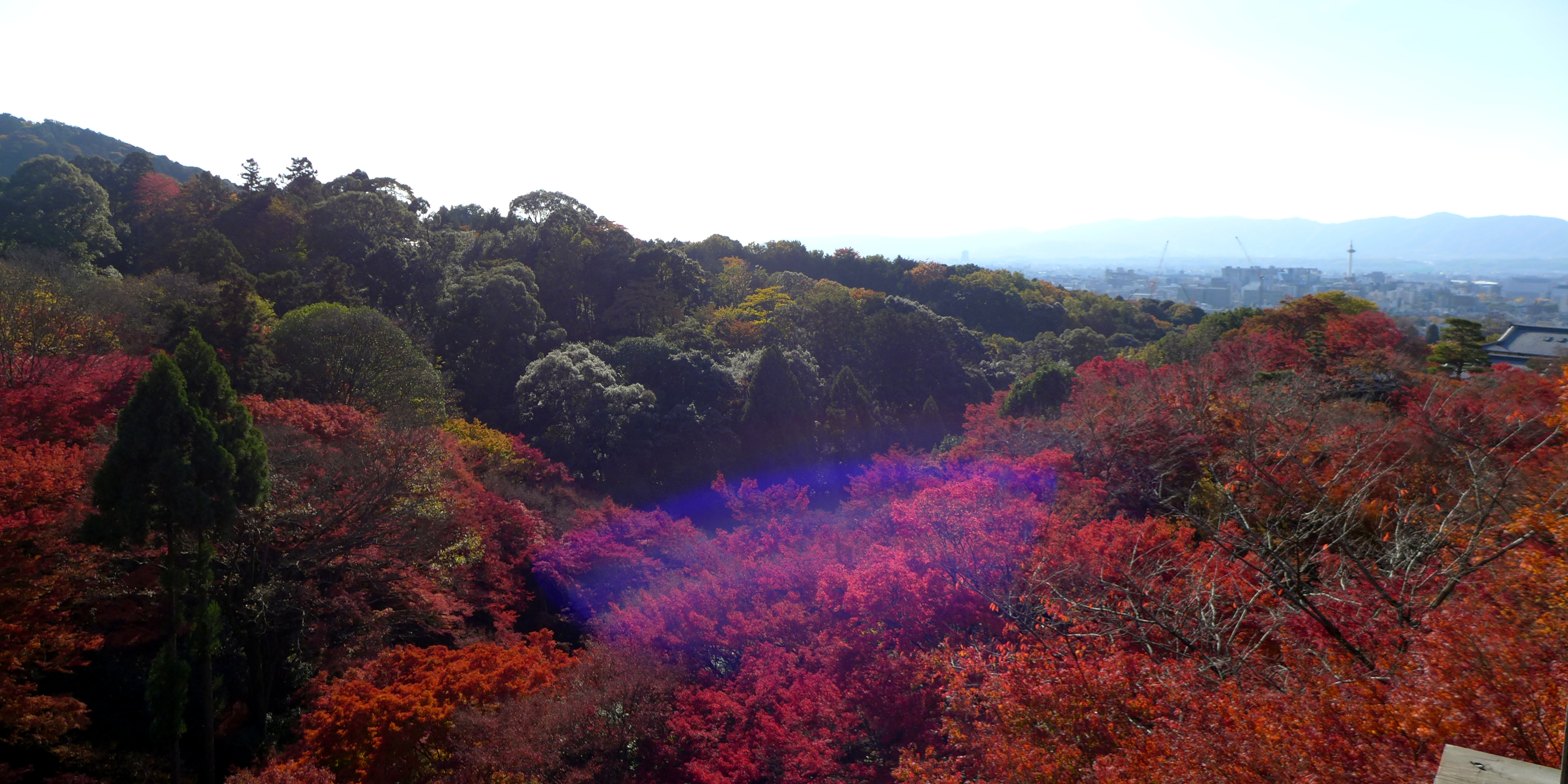
I’ve been lucky enough to get three extra days off university for ‘Dohshisha Eve’ (my university’s Christmas festival thing), giving me the chance to do some more wandering around Kyoto. It was also beautifully sunny, and it’s still koyo (turning of the leaves), so I simply had to take advantage of this luck and visit one of the most spectacular sights in Kyoto. On Thursday I took a trip around several temples (which will be posted about separately), but the temple that unsurprisingly outshone them all was Kiyomizudera, one of Kyoto’s 17 World Heritage Sites.

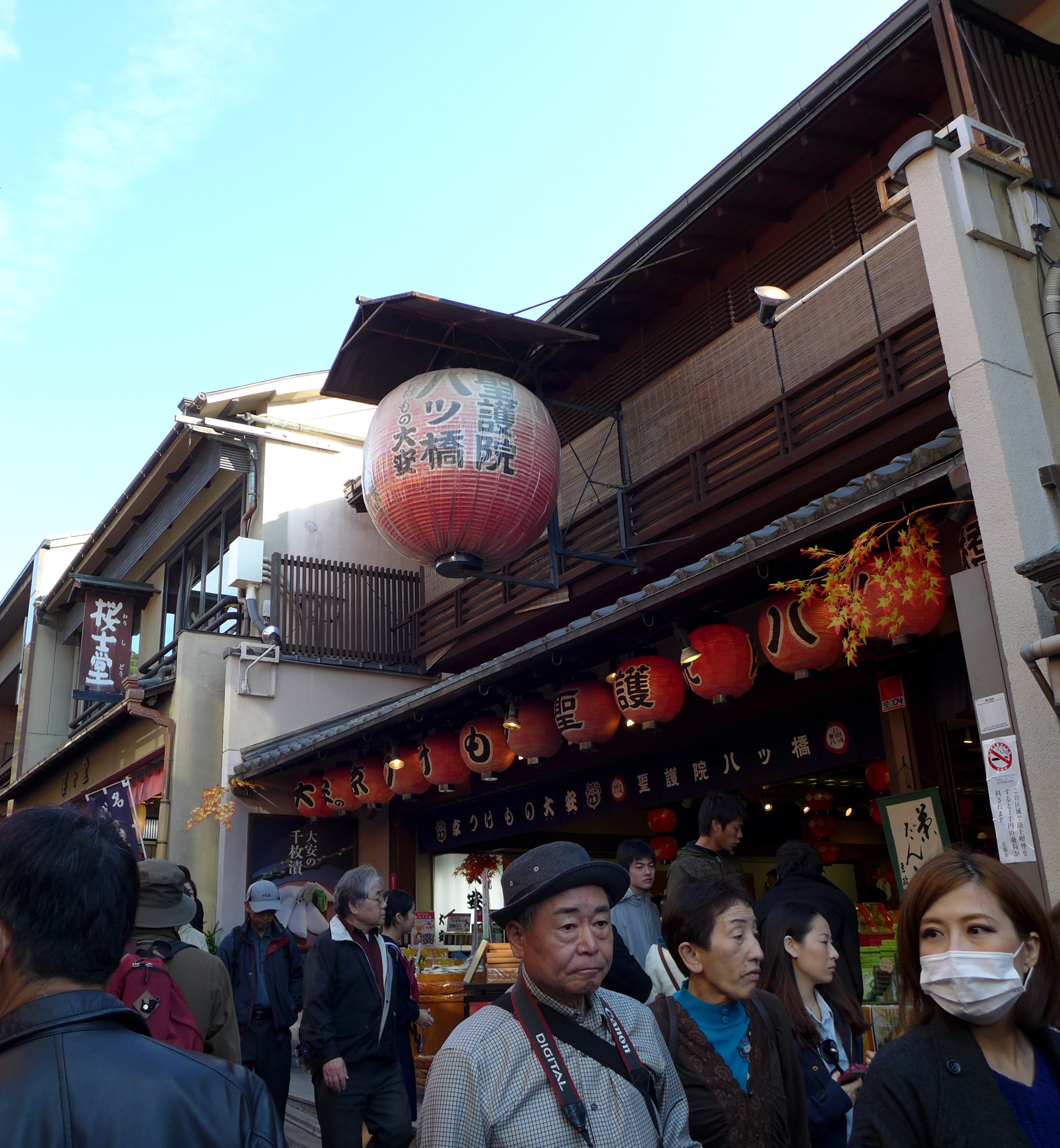
Kiyomizu-dera (清水寺) is located in East Kyoto and is accessible by bus from pretty much anywhere, or you can get the train to Gion and walk through (I would recommend this as the area is worth seeing in itself and there are shrines on the way). Either way you will end up walking up the hill to Kiyomizu-dera as no sane bus driver would challenge the hill road up to the temple which is packed with tourists, shop keepers and, up to a certain point, taxis and rickshaws.
P1020887

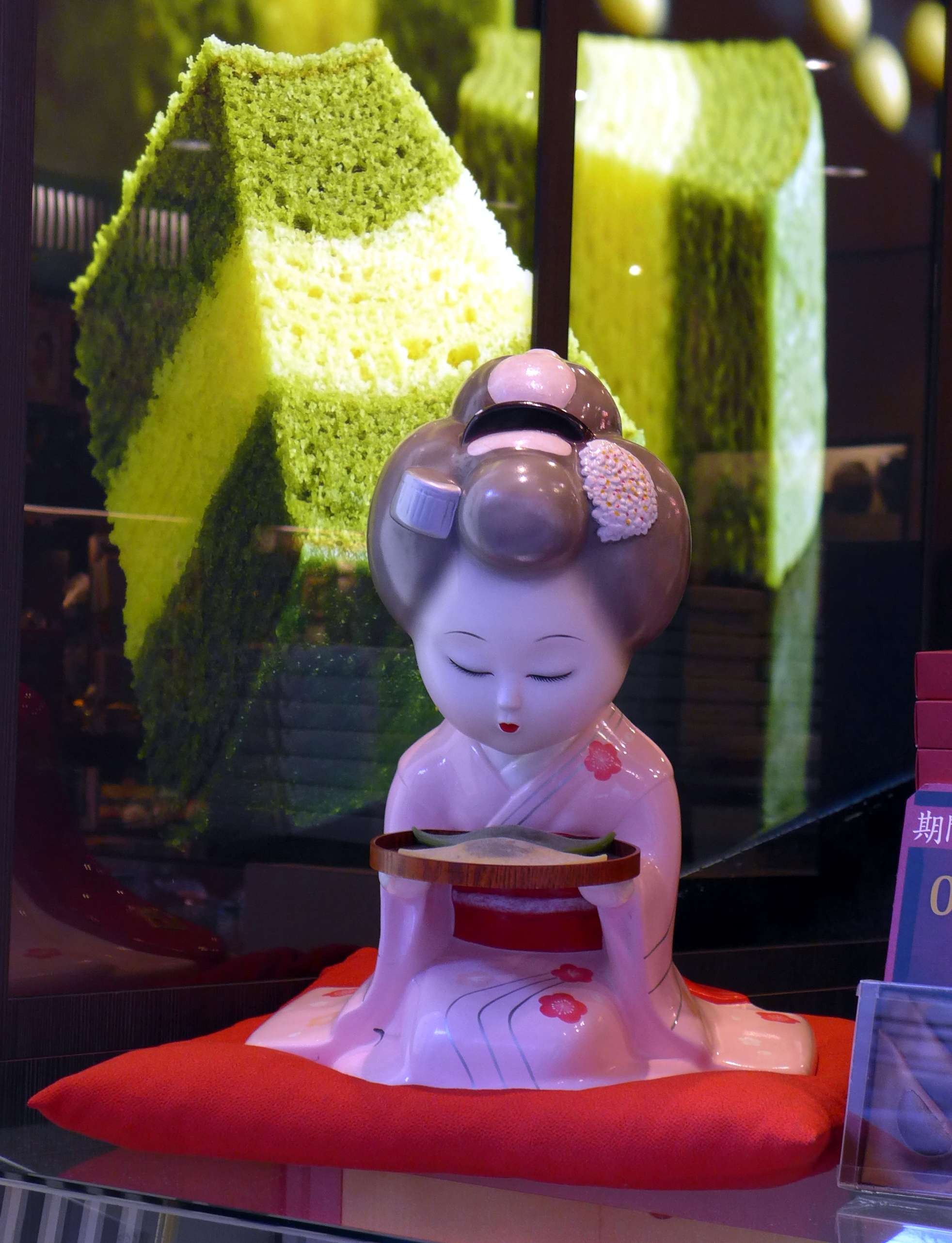
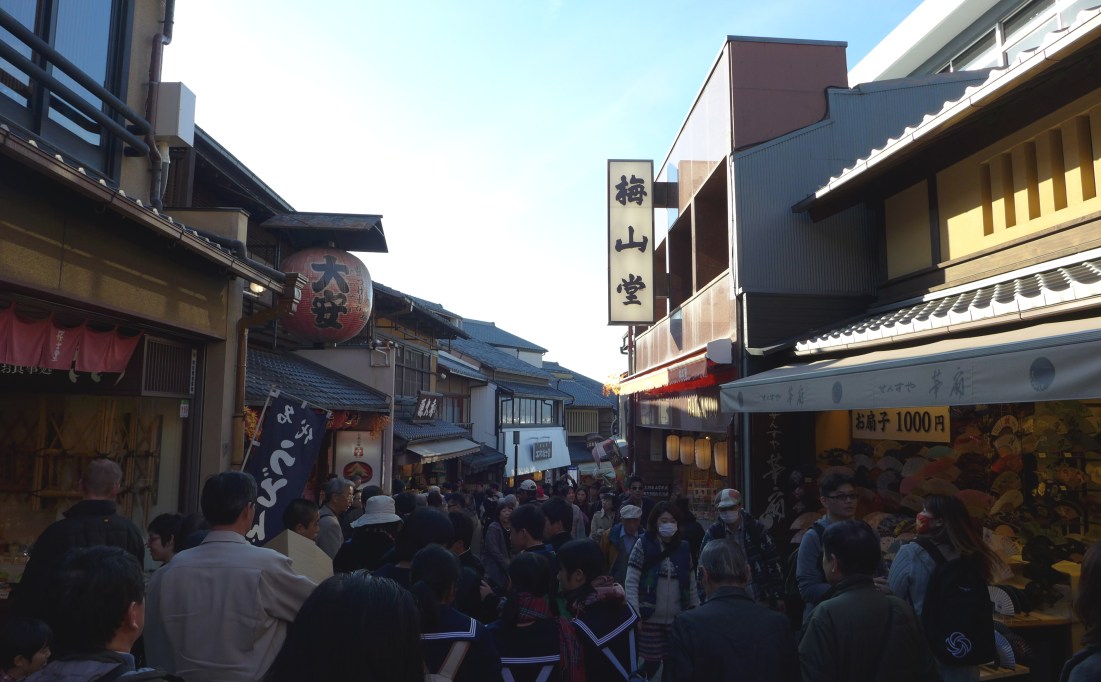
Most of the popular temples in Japan have an ‘approach’ of shops selling o-miyage (お土産) which are presents to take home to your family. In Kyoto this is inevitably yatsuhashi (八つ橋), rice dough pancakes usually stuffed with red bean paste (I had them at Fushimi Inari) or anything flavoured with Matcha (green tea 抹茶). Kiyomizudera is no exception, with a very long approach up the hill, packed with shops selling touristy ‘typically Japanese’ stuff aimed at Westerners as well as O-miyage and better quality traditional goods aimed at Japanese. Most of the shops have big ‘no photo’ signs, probably because they don’t want people hanging around taking pictures without buying anything, but I embraced my inner anarchist and took a couple of pictures of the displays anyway. Purely for your benefit, of course.

P1020892P1020895P1020891P1020829P1020699

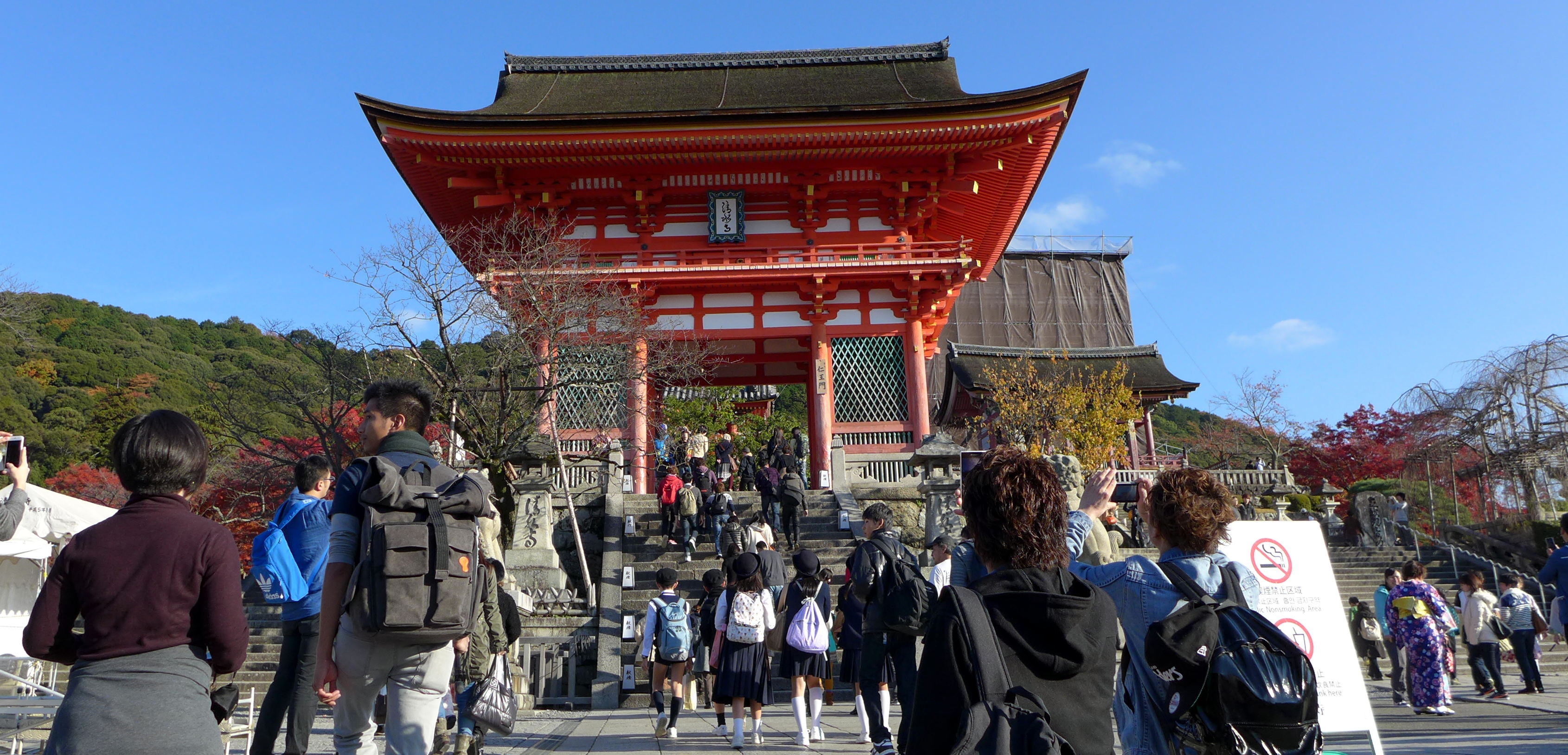
Once you have navigated the ever-growing throng of tourists,  many of whom stop randomly to take pictures or simply do not understand the concept of moving at a reasonable pace, you will eventually catch sight of the entrance gate of Kiyomizu-dera. It is unusual in that it is raised so far above the crowd on a series of steps. I liked the lions flanking the gate, I think they’re meant to be roaring but to me they were laughing at some hilarious joke. You do not actually have to go through the gate to get into the temple as there are paths either side, but the view from the top is worth joining the jam of people on the steps.

P1020704

In all honesty the crowd isn’t that bad, though I did go on a weekday; you won’t be able to take many pictures without someone walking across your photo, but movement is mostly unobstructed and it’s not busy to the point that its genuinely inconvenient and inhibiting. I imagine that on the weekend its absolutely packed though, so it would be best to visit on a weekday if you have the option.

P1020701P1020880 P1020706

Kiyomizu-dera is an independent Buddhist temple that was founded in 778 by Enchin. It was rebuilt in the 17th century because it was burned down in a fire. It is dedicated to the Buddhist god Kannon, the god of mercy, a very popular god throughout Japanese history.

The legend of Kiyomizu-dera’s founding is that Enchin, a priest, received a vision that he would find the source of the Yodo river  (aka the Uji river, that flows through East Kyoto), and he went in search of its origin. During his search he came across a hermit who gave him a piece of wood possessed by the spirit of Kannon. Enchin enshrined the wood in a shelter, founding what would become Kiyomizu-dera. Later, an Emperor was hunting for a stag in the woods near the shrine, and Enchin gave him a sermon on why one should not harm animals (as he was Buddhist), the Emperor was moved and gave him money to create a proper temple.

P1020720 P1020727P1020730P1020722P1020746P1020716

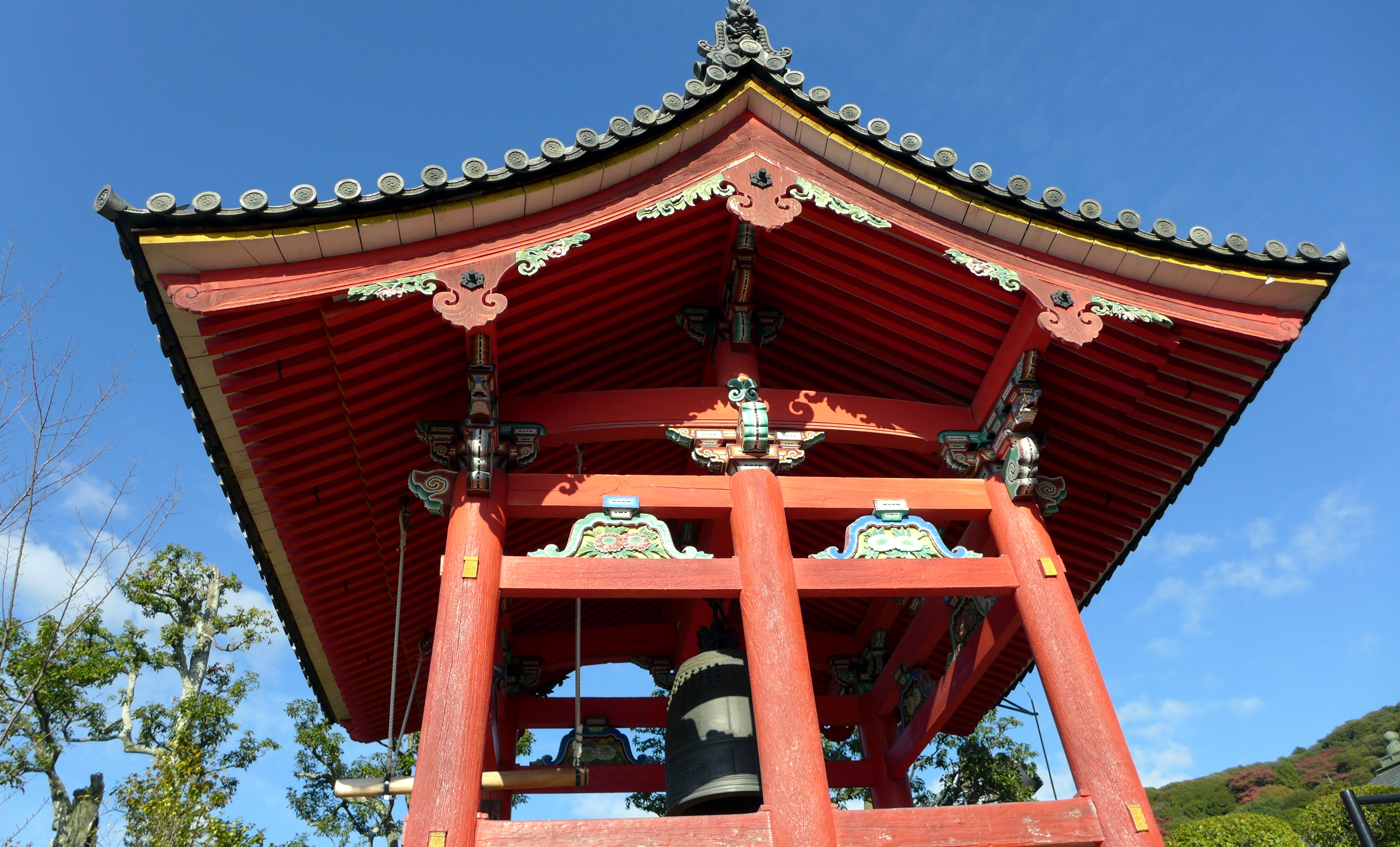
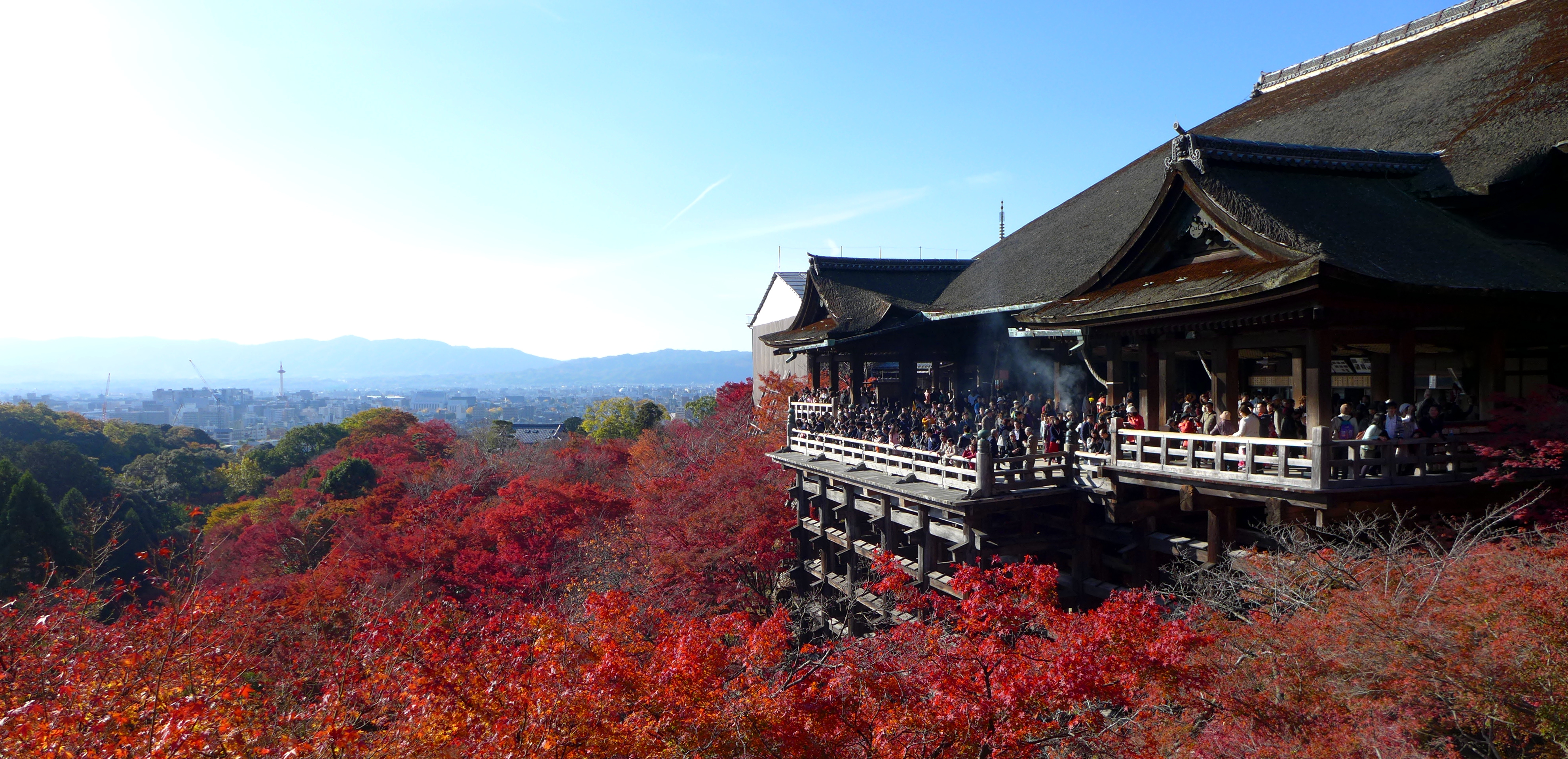
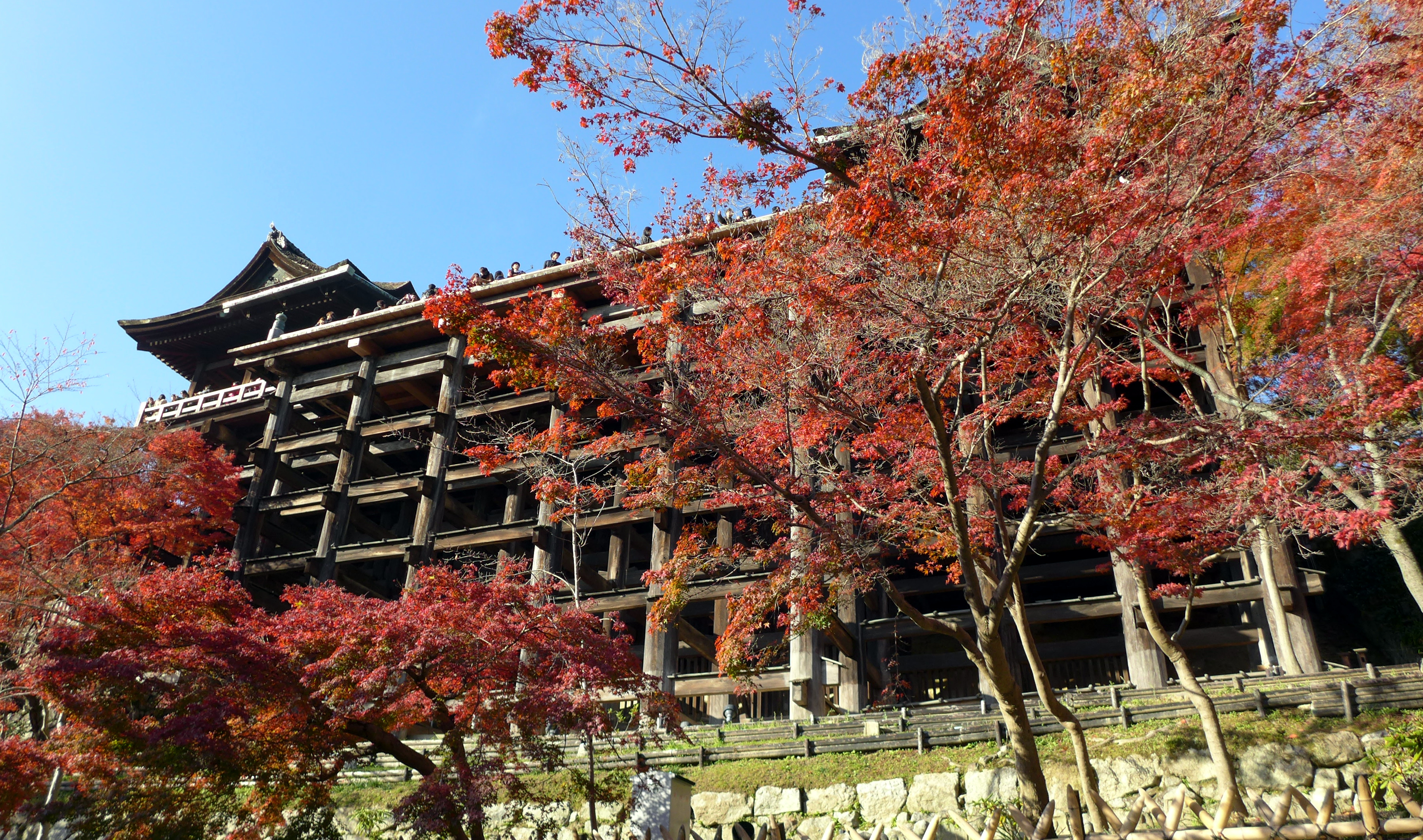
The most astonishing fact I’ve read about this temple is that it was constructed with no nails at all. This is amazing because it’s a very tall structure built on a mountain, and takes thousands of visitors tramping through it every day. I’m sure it’s withstood earthquakes too. I know that its possible to build a very sound structure with no nails, but for some reason this still amazes me. The main temple building is also thatched, which is pretty unusual (probably because most temples seem to burn down, and thatch is only tempting fate).
P1020771P1020742 P1020783

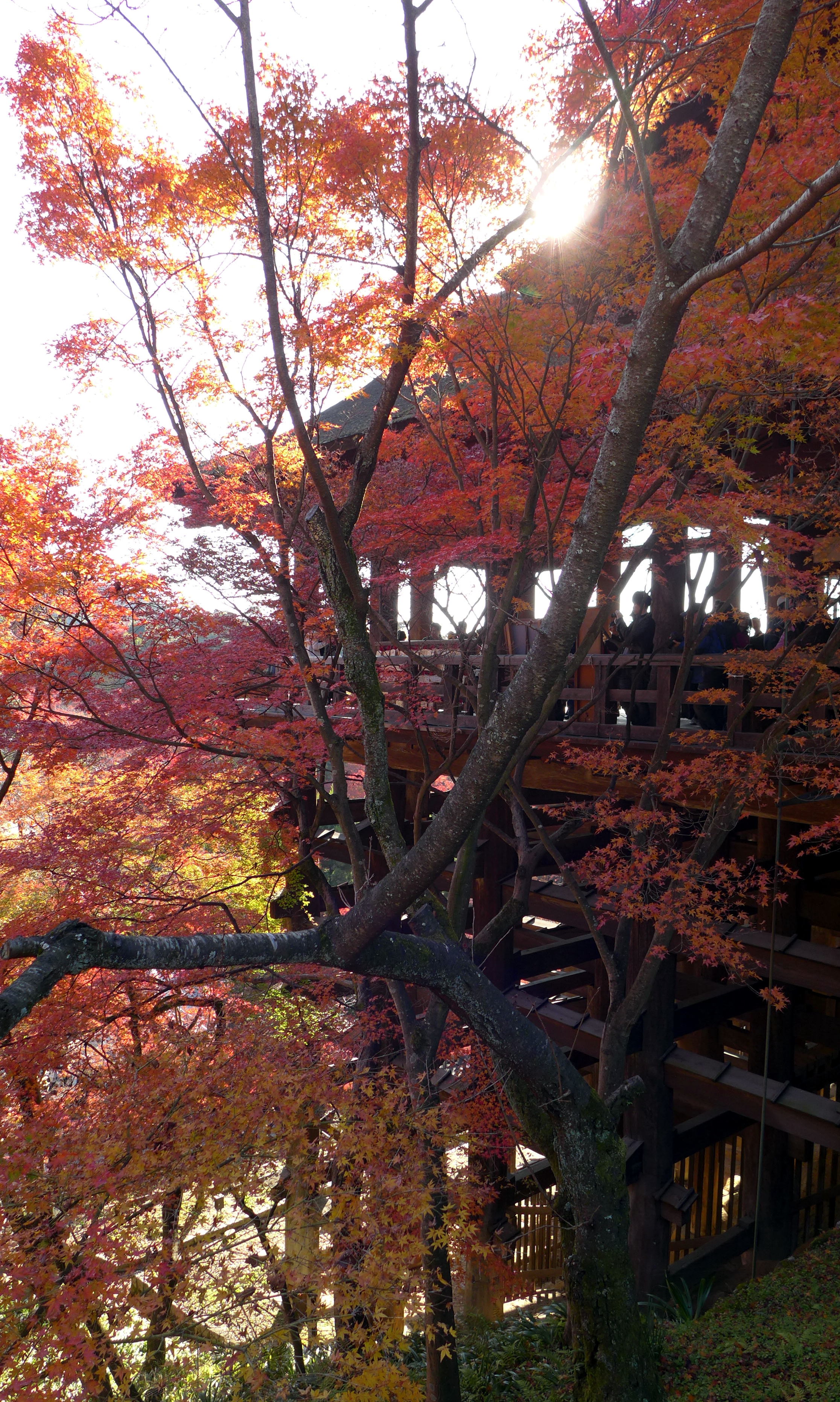
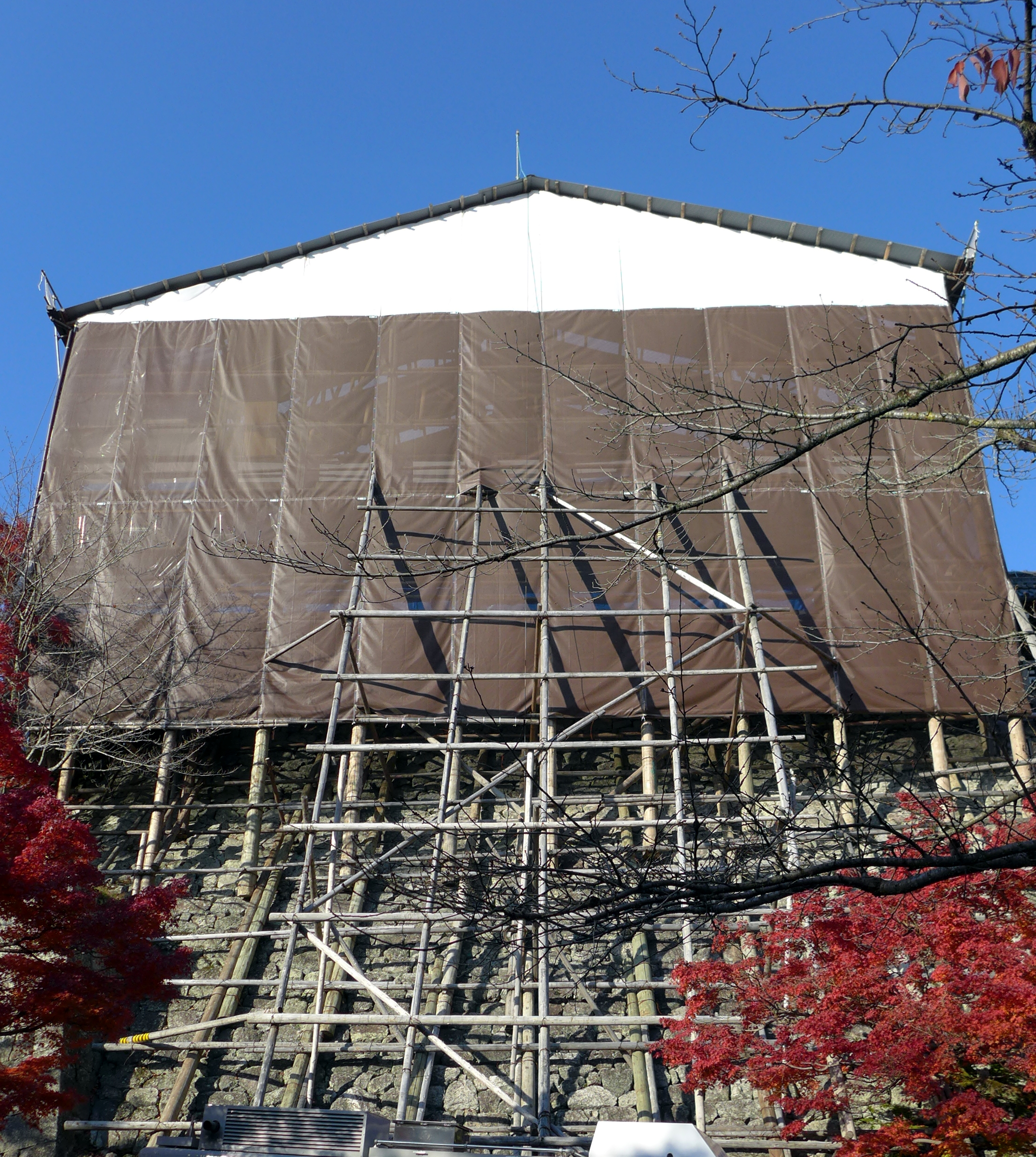
While it does not have any nails, half of Kiyomizu-dera is actually under maintenance. Though this doesn’t spoil the beautiful view over Kyoto, it does somewhat ruin the atmosphere, especially with the loud drilling. Hopefully if you get the chance to visit, they will have finished. It is definitely still worth a visit regardless of the construction work. I still managed to get the iconic ‘postcard shot’ of Kiyomizu-dera’s platform with the city and the crimson leaves – it’s quite amusing that there is scaffolding just out of sight and the view was far from tranquil as it was accompanied by melodious drilling.
P1020857 P1020761

The main attraction of Kiyomizu-dera is the platform that overlooks the trees towards a pagoda on the opposing mountain. In the Edo period people would jump off the 13 metre platform, the idea being that if they survived their wish would be granted. 234 jumps are recorded with a 85.4% survival rate, though I wonder if their wishes were granted, presumably they would be injured by the fall and I wouldn’t trust Edo period medicine (mostly herbalism and acupuncture, not great cures for a broken leg). As a result of this practice, the Japanese version of the English idiom “to take the plunge” is “to jump off the stage at Kiyomizu”.
P1020837P1020765P1020743P1020767

The booth for shuin (朱印, stamping) is just at the end of the first platform and was run by a very nice monk who explained the different sections of my stamp to me. He will explain in either Japanese or English, so if you get yours done the language barrier is no problem (he will also give you a slip of paper with the information). You can also buy stamp books there with the main stage of Kiyomizu printed in gold on the front.

As you are probably wondering what the stamp explanation was:

The right hand side has the date (going down to the bottom right), followed by the character 奉拝 (Hohai) meaning to worship in the top right next to the date, the large central characters are 大悲閣 (Dai-hikaku) meaning ‘great benevolent palaces’, the final characters on the left are the name of the temple, 清水寺 (Kiyomizu-dera).

Most stamps follow a similar pattern, with 奉拝, often followed by the name of the temple (or its official rather than common name) and then its other name (usually common name on the left). The date is usually on the left or the right, there doesn’t seem to be a convention.

P1030460 P1020751 P1020760

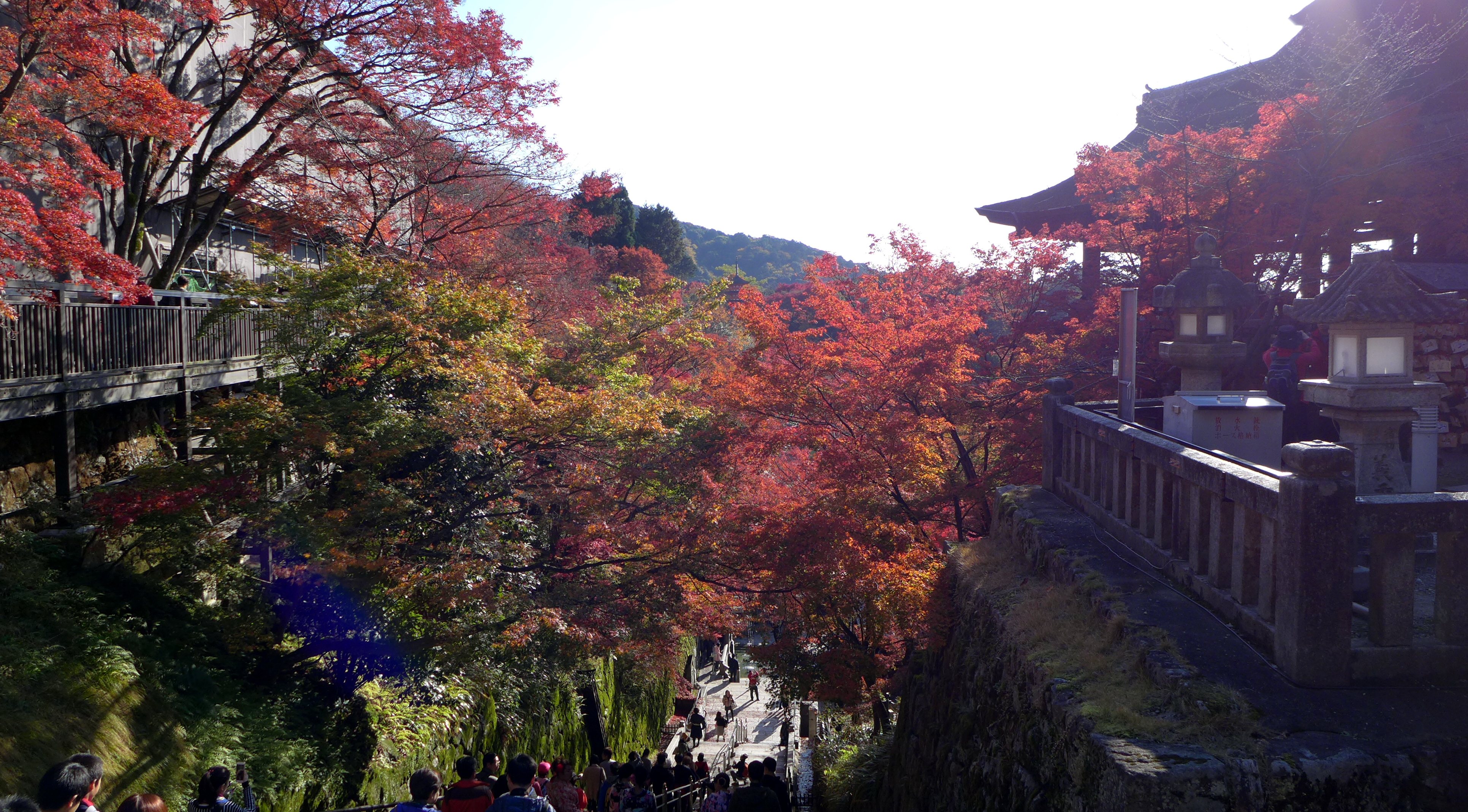
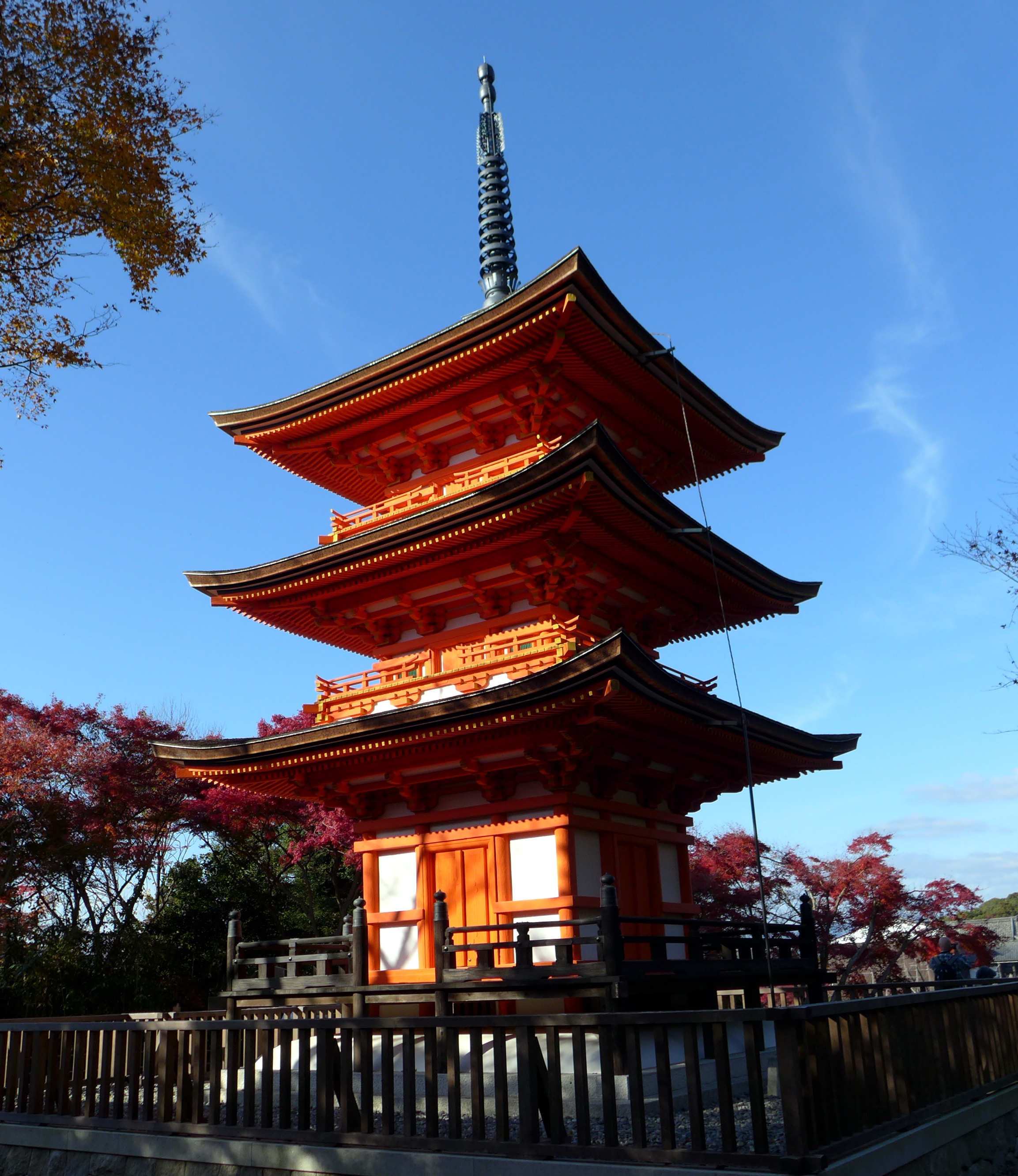
If you continue on round the stage instead of going down the steps towards the water, you will reach a path leading up to the pagoda. The pagoda is pretty small close up (it looks like it could be huge and just really far away from the temple itself) but its beautifully detailed and you can look back towards the temple at the gallery you were just standing on. The view of the leaves is better from the temple but the view is still spectacular.
P1020774P1020804P1020808

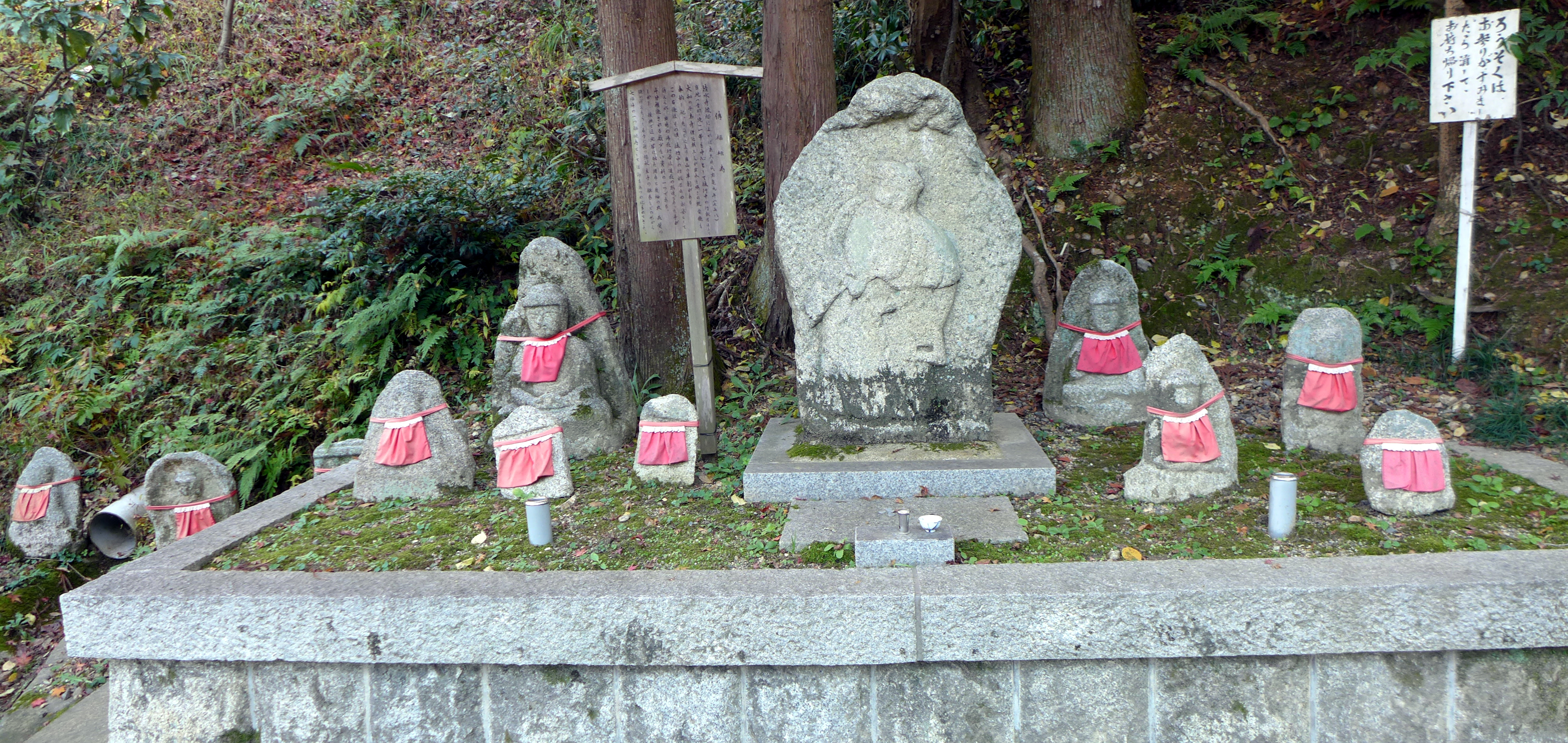
I then walked down the hill towards the section of the temple under the gallery. The elevation makes the temple dynamic and interesting to walk around – you discover new areas as you walk around. Here there was a queue of people waiting to scoop water from an elevated spring. It is said that if you wash yourself and drink the water your wishes will be granted. I didn’t queue because an entire school had just joined the line and I didn’t particularly want to wait half an hour. When I have a wish that needs granting I’ll be sure to go back.
P1020819 P1020833 P1020868 P1020864 P1020855

While Kiyomizu-dera is firmly on the beaten track, and therefore subject to traffic, I can see why its become so famous. There is also an evening illumination of the leaves during Koyo, but I have heard that people start queuing two hours before the illumination opens – though I’m sure its worth the wait, I doubt I’ll be joining the line. Entrance to Kiyomizu on a normal day does cost money, a ticket costs 300円 (£1.60), which is cheap for such an attraction – many temples charge more for much less.

日本 Limited Democratic Process

On November 14th, Prime Minister of Japan, Mr Shinzo Abe, called a snap election due to take place on December 14th. This has been declared a ‘gamble’ by the media (eg Reuters) and perhaps calling a verdict on ‘Abenomics’ – Mr Abe’s attempts to drag Japan out of recession. But is this really such a gamble? Who is he even up against?

You, as a non-Japanese reader (I assume), may not know much about Japanese politics, and probably don’t feel its particularly relevant to you or your country. However, I find Japanese politics interesting for several reasons (and you probably should too):

Firstly, Japan is an example of an ‘engineered democracy’ – Japan’s democracy was crafted by the American occupation in the 1950s. This is interesting for two reasons; democracy never came ‘naturally’ to Japan, it was ‘imposed’ from the outside onto a people that had lived under military rule for a thousand years. Also the American occupation created their ‘ideal’ democracy, one they felt was conducive to the American interests of demilitarisation and democratisation. However, these ideals did change during the occupation due to fear of cold war with Russia, and plans such as the break up of corporate ties to government were scrapped in favour of building an economically strong Japan. These origins are still evident in Japanese politics today. This creation of democracy is unique – the US has attempted to create democracy in countries such as Afghanistan with limited success; Japan is the only country that the US could perhaps claim a true democracy has blossomed.

If you are a UK citizen, you might not have thought that carefully about similarities between Japan and the UK. Both are are island nations just off a major continent, both have constitutional monarchies, both used to have an empire (which included oppressing the natives of those colonies) and both face economic stagnation in the 21st century. Japan’s democratic system is partially based on the Westminster model; Japan has a bicameral (two chamber) system (though both are elected) and has a cabinet and prime minister. However, while UK politics swings between two major parties (a system that many feel is ‘broken’ or unfair), a ‘one and a half party system’ has emerged in Japan. By looking at Japan’s political environment we can anticipate what might happen if we were to alter the First Past the Post system in the UK and draw some similarities between UK parties and Japan’s LDP.

Japanese politics is also interesting as changes in Japanese politics can affect the rest of Asia – I’m sure most of you are aware of Mr Abe’s alteration of Article 9, the article that prevents Japan from having an army. You may also have read several articles about Mr Abe’s apparent nationalism and his controversial visit to Yasukuni shrine. The increasing nationalism of Mr Abe’s policies affects Japan’s relations with China, and as Japan is still tightly bound to US foreign policy, it also affects USA policy towards China (as well as potential for war in East Asia).

So hopefully I’ve convinced you that Japanese politics is at least worthy of some light reading. While I could talk about the origins and history of post 1945 Japanese politics for hours, I’d like to focus on the main party of Japan and the opposition as these are the main players in the next election.

For those familiar with Japanese politics, its all about the LDP. The Liberal Democratic Party of Japan (LDP) or the jiminto (自民党), has been the ruling party of Japan since 1955, and has been in power (or coalition) for 55 years and has only lost power twice. In this sense it is one of the most successful political parties on Earth. As such isn’t it odd to call Abe’s snap election a ‘gamble’? The odds are surely in the favour of the LDP and if you’re the opposition, it doesn’t look good.

Man of the Hour

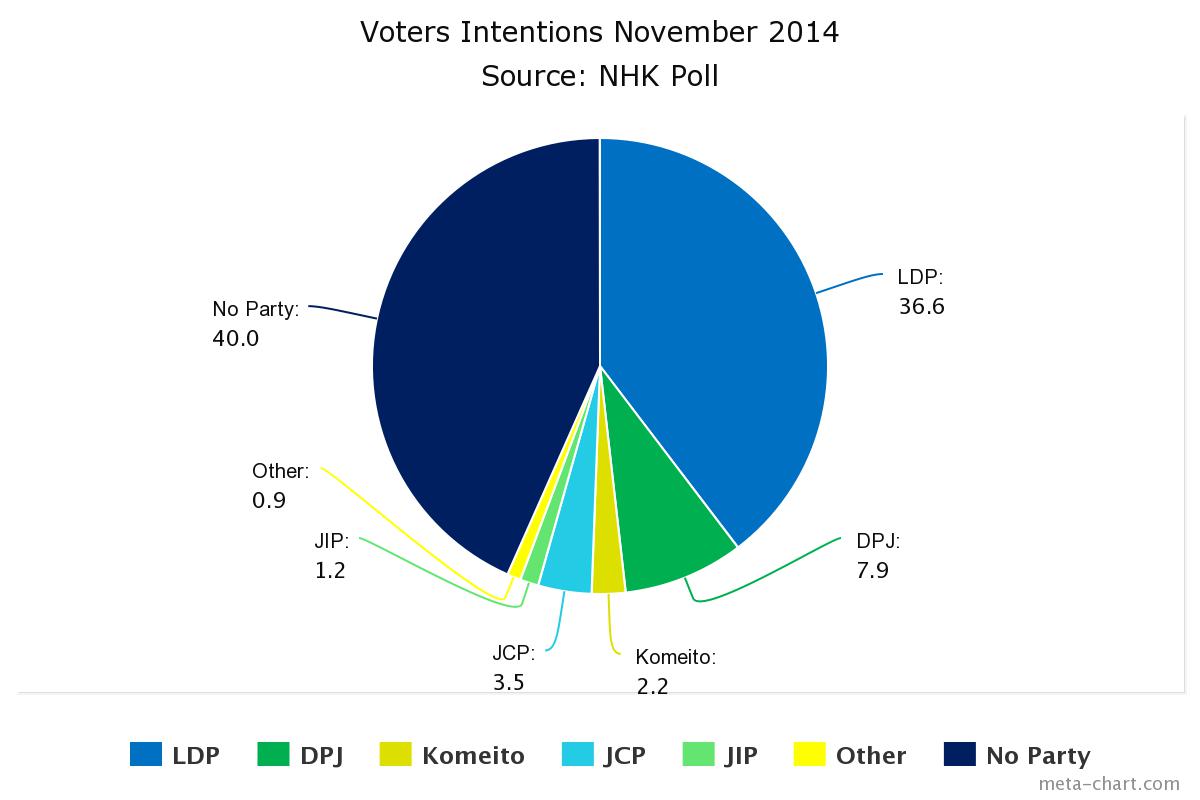
The opposition of Japan has pretty much always been weak in the post-war period, hence the name ‘one and a half party system’. The current main opposition of the LDP is the Democratic Party of Japan (DPJ) or minshuto (民主党), the party that defeated the LDP in 2009 and ruled until 2012. The fact that this victory over the LDP was so recent suggests that there is hope for a DPJ success once more. However, as of the beginning of November, polls suggest 36.6% are planning to vote for the LDP, with only 7.9% for the DPJ and 40% are undecided (source). These undecided voters are unlikely to swing the election for the DPJ and many may vote for independents or simply not vote at all. 

pieChart_jpg (1)

I made you a pie chart and everything

The issue facing the DPJ is that they do not have radically different policies to the LDP. When we talk about British politics we think of conservative and labour, and in US politics the differences between Republicans and Democrats are painfully clear, but the vast majority of people in Japan regard themselves as middle class and there just aren’t that many divisive social policies to set up a party around. There is a Communist Party of Japan (CPJ, or nihon kyosan-to 本共産党) and the Buddhist Komeito party (公明党), but both appeal to very specific minority groups and will never gain enough traction to become a majority party – Komeito often becomes a coalition party whereas the CPJ refuses to jump into bed with any other party (it is the only party that still retains ‘integrity’ in this respect). There is also the very new Japanese Innovation Party (JIP, or ishin no to 維新の党) about which there is little information other than that they are a nationalist group and probably won’t do very well. The DPJ claims to be a ‘pioneering’ party, but the reality is that most of its members are ex-LDP that became disillusioned with faction politics within the LDP itself. This taints the credibility of the DPJ as ‘different’ to the LDP in the eyes of voters – though the LDP is seen as corrupt, the DPJ is often seen as no different.

The LDP’s hegemony must have some systematic support surely? How can one party remain in power with no real challenge for 50 years? If you are asking these questions, you’re right; though the democracy was built as an ‘ideal’ by the US, they failed to grow a true democratic system. From the beginning the US sponsored the LDP and disapproved of any left leaning parties due to fear of communism spreading to Japan. This LDP headstart has been propped up by these systematic exploits:

  • ‘Pork Barrel Politics’: the countryside of Japan has more power than the cities; there are more candidates per 1000 citizens in the countryside than there are in the cities. As a result the LDP just had to maintain generous agricultural subsidies to secure the countryside vote. Each candidate would also build a personal network of voters that they would visit and dine, securing votes that those with no links to central government would struggle to get – LDP candidates already in government or linked to those that were could promise policy changes that those locked out from government are unable to do. Though there were reforms on gerrymandering, these activities are still part of the LDP election machine.
  • Election restrictions: candidates are only allowed a short spot on TV, cannot hand out leaflets outside of a standard format and cannot buy space on radio or in newspapers. Though this is all in the name of making things ‘fair’ it means that candidates that are not in government are virtually unknown to voters. It also results in some creative campaigning – at the moment if you walk around any Japanese city you will hear politicians shouting at the general public over megaphones strapped to the roof of a car. It gets very annoying after a while. They literally just drive round and round the block yelling their policies at passers-by.

  • Centralisation: most funding for local government is handed out by the central government. This means that areas that don’t vote LDP may see a cut in funding or a lack of public works projects in the area. This means that a lot of local government ends up being LDP, giving LDP candidates more exposure to the public and preventing small parties from getting a foot on the first rung of the ladder to the national assemblies.

There are other factors in LDP hegemony but these are the obvious reasons. However, I would argue that despite what looks like a guaranteed LDP victory, this may still be a ‘gamble’ for Mr Abe. This is because we can look at the LDP itself as a coalition of parties, or factions, all vying for power. The LDP is often referred to as a ‘catch all party’, perhaps this is because the LDP is a political system within itself. LDP factions often decide the Prime Minister – despite no electoral turnover, from 2006 to 2009, Japan went through a rapid succession of 3 different Prime Ministers. This can be put down to different factions within the LDP gaining the upper-hand within internal politics. Perhaps if Mr Abe’s election is not as successful as he hopes, and his reforms continue to fail to drag the Japanese economy out of recession, he could see himself ‘unelected’ by the LDP factions.

Hopefully this post makes you a little more interested in the upcoming Japanese election. The questions I am asking are: Is the LDP back in power for good or can the DPJ make a comeback? Is Mr Abe going to cling to power for the long-term or is he just another ‘stepping-stone’ PM for the LDP? And how many Japanese will vote? – that 40% undecided suggests apathy within the electorate. I eagerly await the election, partially because I’m sick of the megaphone cars.

If you stuck it out to the end of this post, congrats. This was partially born out of me attempting to decide on a dissertation – I want to focus on Japanese politics but I really can’t decide on an area and hashing out the current political background is helpful. Normal temple sight seeing programming will resume soon!

Sources / Recommended Reading:

  • Hunter, The Emergence of Modern Japan, Longman (1989)
  • Moore and Robinson, Partners for Democracy: Crafting the New Japanese State under MacArthur, Oxford (2002)
  • Neary, The State and Politics in Japan, Polity (2002)
  • Scheiner, Democracy without Competition in Japan: Opposition Failure in a One-Party Dominant State, Cambridge University Press (2006)
  • Stockwin , Governing Japan (fourth edition), Blackwell (2008)